laminated & rolled «tsoureki» brioche bunslaminated & rolled «tsoureki» brioche bunslaminated & rolled «tsoureki» brioche bunslaminated & rolled «tsoureki» brioche bunslaminated & rolled «tsoureki» brioche bunslaminated & rolled «tsoureki» brioche bunslaminated & rolled «tsoureki» brioche bunslaminated & rolled «tsoureki» brioche bunslaminated & rolled «tsoureki» brioche bunslaminated & rolled «tsoureki» brioche bunslaminated & rolled «tsoureki» brioche bunslaminated & rolled «tsoureki» brioche bunslaminated & rolled «tsoureki» brioche bunslaminated & rolled «tsoureki» brioche bunslaminated & rolled «tsoureki» brioche bunslaminated & rolled «tsoureki» brioche bunslaminated & rolled «tsoureki» brioche buns

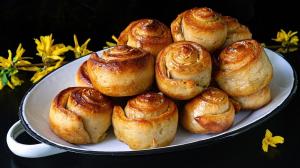
The laminated “tsoureki” or “tsourekaki”, like a little brioche or ensaïmada, represents the fourth major evolution of my search for the ultimate Hellenic crumb. While rooted in the foundations of my 21st century tsoureki recipe (see that recipe and more detailed photos of the ingredients here), this version pivots away from traditional heavier bread and thicker spirals toward a refined, layered and architectural yet airy format. It is a deliberate move from the rustic to the intricate, distilling the best of our previous experiments into a technically superior, smaller-scale masterpiece.

Lamination is a universal culinary language of layers; while the French fold, the Greek tradition has long mastered the "leaf" through Phyllo. By adopting the stretched lamination technique for this dough, we are reconnecting with a broader Mediterranean heritage of thin-layer pastry-making that spans the Aegean and Ionian seas to the Balearics. This isn't just a foreign trick; it is a return to a shared maritime history of doughs and fats.

Inspired by the mallorcan ensaïmada (see recipe here), we replace the dense bready brioche pull of the past with a hand-stretched dough. The application of smooth clarified butter creates a labyrinth of internal layers. This fundamentally alters the palate experience, so instead of a singular, thick crumb, you are met with many more delicate layers that shatter, unravel and melt, offering a "shred" far more sophisticated than any traditional sweet loaf.

The flavor remains deeply Hellenic, featuring a resinous base of masticha, mahlepi and ground clove balanced by a vibrant triple zest of orange, lemon, and lime. By prioritizing orange blossom water, ouzo, and vanilla in the liquid mix and utilizing a slower 24-hour total process and 18-hour cold and room temperature ferment, we ensure these aromatics are cured directly into the dough's protein structure. The result is a scent profile reminiscent of a Mediterranean garden in full bloom.

Finally, the transition to a 45g raw dough bun format (before the buttering and baking and glazing) optimizes the sensory balance. Unlike a large loaf, these individual spirals maximize surface area for the honey-syrup glaze on top and flaked almonds embedded between the layers. Every bite captures the crisp shatter of the exterior and the tender, aromatic unspooling of the center. 

These "honeyed aromatic spirals" are a living dialogue between cultures, a piece of culinary architecture designed for the modern feast … :)

laminated & rolled «tsoureki» brioche buns

04.04.2026

20 x 55 grammes chacune

ingredients

dry flour mix :

  • 475g (3 ¾ cups + 1 tbsp) all-purpose flour (11% protein) or 500g bread flour (12-14% protein)
  • 20g (2 tbsp) vital wheat gluten (or omit if you have bread flour)
  • optional : 5g (1 ½ tsp) non-diastatic malt powder (or add 2 tsp more flour)

aromatic dry mix :

  • 100g (½ cup) extra-fine sugar
  • 3g (1 ½ tsp) orange zest (from 1 medium orange)
  • 2g (1 tsp) lemon zest (from 1 large lemon)
  • 1g (½ tsp) lime zest (from 1 small lime)
  • 3g (1 tsp) ground mahlepi seeds
  • 2g (½ tsp) ground masticha crystals (ground when frozen, with a pinch of the sugar)
  • 1g (¼ tsp) ground cloves
  • 5g (1 tsp) fine sea salt

liquid mixes :

  • 165g (2/3 cup) whole milk (lukewarm)
  • 15g (3 tsp) crumbled fresh yeast
  • 100g (2 large) whole eggs (room temperature, weight without shells)
  • 15g (1 tbsp) orange blossom water
  • 10g (2 tsp) ouzo
  • 5g (1 tsp) vanilla extract

layer lamination :

  • 160g (¾ cup) clarified butter (smooth "pomade" paste consistency) for the dough and the tins
  • 40g (3 tbsp) golden coarse cane sugar (for friction between layers)
  • 40g (6 tbsp) flaked almonds, slightly crushed (for friction and crunch)

glazing syrup :

  • 80g (4 tbsp) honey 
  • 30g (2 tbsp) water 

instructions

day 1 : prepping & fermentation

  • clarify 220g of unsalted butter to yield 160g of pure fat by slowly melting and simmering over low heat (do not boil nor brown), skimming and discarding the froth and then straining it through a sieve or coffee filter, avoiding the milk and watery sediment at the bottom; and to prevent graininess, place the fat in a cup in the freezer for 5-minute bursts, stirring vigorously between each until it reaches a thick, opaque, and perfectly smooth "pomade" state; cover and leave on the counter to maintain a soft, spreadable consistency until the next day (125g will be for laminating the dough and 35g for greasing the baking tins)
  • prepare the dry flour mix (without the salt) and the aromatic dry mix in 2 separate bowls and set aside
  • dissolve the yeast in lukewarm milk with 2 tbsp of the flour mix and wait 10-15 minutes until frothy, then whisk in the orange blossom water, ouzo, and vanilla, followed by the eggs
  • *note : if you are in a rush, you can double the yeast and halve the fermentation/rising time … but that’s more volatile so you have to pay more close attention to the dough rise !
  • whisk the dry flour mix and aromatic dry mix together in a stand mixer (except for the salt)
  • combine wet and dry mixtures and knead on medium speed for 10-15 minutes, add salt now and knead again (the dough will be compact and smooth and ideally not tear easily when stretched)
  • place the dough in an oiled bowl and let it rest at room temperature for 2 hours to "kickstart" the yeast and cover tightly and refrigerate (5°C-6°C) for 12  hours

day 2 : shaping & baking & glazing

  • remove the dough from the fridge and let it sit, covered, for 2 hours, divide the dough into two equal halves and roll the first half into a 25 cm (H) x 40 cm (W) rectangle and 5 mm thickness (you’ll repeat for the second dough rectangle, after this one is done)
  • spread 62g of the butter pomade over the surface and sprinkle with 20g of the “friction” sugar and 10g of crushed almonds and lightly press them into the butter 
  • chill the flat sheet in the fridge for 30 minutes to "lock" and firm up the layers and then roll tightly from the 25 cm side upward to form a 40 cm long log and wrap the logs and flash-freeze them for 30 minutes
  • mark every 4 cm and use a sharp knife to slice through the log, creating ten 4 cm wide mini spiralled logs (repeat with the second log)
  • butter the twenty 8 cm x 4 cm individual aluminum muffin tins with the remaining 35g clarified butter and place each small log cut-side-down in the center and proof in a room temperature, humid spot for 2 hours (or until the dough crowns or rises almost 1 cm above the rim)
  • *note : room temperature rising time will depend on you room temperature and your refrigerator temperature beforehand, and the freshness or strength of your fresh yeast, so judge the timing with your eyes and not just a clock …
  • preheat the oven to 170°C (340°F) with a flat pan of hot water on the floor of the oven (to create steam) and bake for 20 - 22 minutes until golden (ideally for 10-11 minutes covered with a lid and 10-11 minutes without a lid) and loosely tented with foil after 15 minutes of baking (if getting too dark on top) 
  • while baking (or preferably before), simmer the honey and water for 3-5 minutes, then cool the syrup to room temperature or chill and then brush the cool syrup onto the hot buns immediately after removing them from the oven
  • unmold the buns after 5 minutes, remove from the tins and let the buns cool on a wire rack

storage & reheating :

  • once completely cool, store in an airtight container with parchment paper between layers to prevent the honey glaze from sticking and keep at room temperature for up to 48 hours
  • for long-term storage, freeze the buns until solid, then transfer them to air-tight freezer bags for up to 3 months
  • for reheating, never use a microwave, to revive the "crispy shell," lightly spray the buns with water, heat buns in a metal container with a lid at 165°C (330°F) oven for 8-9 minutes (10–15 minutes if frozen) until the butter inside melts and the exterior recrisps

*note for approximate 21-24-hour slow timeline :

  • day 1 / 5:00 pm: clarify butter and begin the cooling & stirring ritual / 5:30 pm: prepare yeast mixture and knead the dough (30 mins) / 6:00 pm: room temperature rise for 2 hours / 8:00 pm: transfer to fridge for 12 hours cold fermenting ... 
  • day 2 / 8:00 am: remove dough from fridge to temper for 2 hours / 10:00 am: flatten, smear, sprinkle and chill sheets / 10:30 am: roll logs and wrap and chill/freeze for 30 minutes / 11:00 am: butter the tins and slice the logs / 11:30 pm: final proof for 2 hours / 1:30 pm: bake for 20-22 minutes / 2:00 pm: syrup-glaze and unmold …