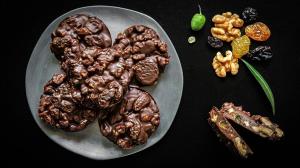
walnut & raisin chocolate clusters (with olive oil & mastic resin)walnut & raisin chocolate clusters (with olive oil & mastic resin)walnut & raisin chocolate clusters (with olive oil & mastic resin)walnut & raisin chocolate clusters (with olive oil & mastic resin)walnut & raisin chocolate clusters (with olive oil & mastic resin)walnut & raisin chocolate clusters (with olive oil & mastic resin)

Rustic roots, modern geometry, newer flavors; the greek walnut & raisin cluster, reimagined with hints of olive oil and aromatic "masticha" resin !

There is a profound beauty in the simplicity of walnuts and raisins. It is an intrinsically Greek combination, perfectly suited for snacking and sharing. I still remember how my father used to crack walnuts right in the palms of his hands, passing us a small handful alongside sweet plump raisins. It is a pairing that requires absolutely no embellishment, rooted entirely in the quality of the raw ingredients.

Yet, the mechanical foundation of translating that memory into a chocolate cluster requires a bit of structural refinement. Traditional chocolate clusters can be thick, jagged, and difficult to bite into, often shattering sharply against the teeth rather than yielding. By introducing just a little extra virgin olive oil to the melted dark and milk chocolate, the crystalline structure of the cocoa butter is gently disrupted. The result is a clean, matte matrix that bites with a soft, fudgy texture, perfectly bridging the earthy walnuts and the chewy fruit.

To firmly anchor the flavor profile in its Greek origins, the sweetness of the chocolate and raisins is offset by crushed mastic resin. Masticha brings a sharp, piney, and resinous brightness that cuts beautifully through the richness of the chocolate. Ground with a pinch of sugar into a fine dust, it disperses seamlessly into the fat, acting as an aromatic counterweight that makes the entire cluster taste distinctly, unmistakably Hellenic.

Finally, the presentation bridges the gap between rustic charm and contemporary culinary minimalism. By pressing this heavily loaded mixture into flat discs, the clusters become effortless to eat while presenting a striking visual geometry. The bumpy, textured tops of the coated raisins and walnuts contrast beautifully against the sharp, dark edges of the chocolate.

Whether you choose to shape them loosely in mounds on parchment or press them into pristine silicone circles, I highly encourage you to try this technique.

It transforms a simple handful of fruit and nuts into an elegant, perfectly balanced bite ! ... :)

walnut & raisin chocolate clusters (with olive oil & mastic resin)

17.10.2026

8 x 56g each

ingredients

  • 100g (1 cup) walnuts (coarsely broken and lightly toasted)
  • 150g (1 cup) multi-colored raisins
  • 100g (¾ cup) milk chocolate (finely chopped)
  • 100g (¾ cup) dark chocolate (finely chopped)
  • 2.5g (1/2 tsp) extra virgin olive oil
  • 0.25g (2 to 3 medium tears) mastic resin (masticha)
  • 0.25g (1 pinch) granulated sugar (for grinding the mastic)
  • 0.25g (1 pinch) vanilla powder
  • 0.25g (1 pinch) flaky salt

instructions

  • grind the mastic : place the mastic tears and the granulated sugar into a mortar and pestle; crush them together until the resin shatters into a fine, dry powder (the sugar acts as an abrasive to prevent the resin from gumming up the stone)
  • melt and emulsify : place the milk chocolate and dark chocolate into a heatproof bowl set over a saucepan of barely simmering water (a bain-marie); once melted, stir in the extra virgin olive oil until fully incorporated and smooth; remove from the heat
  • coat the inclusions : add the toasted walnuts, the multi-colored raisins, the prepared mastic powder and the vanilla powder into the warm chocolate; fold the mixture gently (with the higher ratio of fruit to chocolate, take extra care to ensure every piece is completely enrobed)
  • shape the clusters : depending on your preferred presentation, choose one of the following shaping methods :
  • the free-form drop (most rustic): spoon the mixture directly onto a baking sheet lined with baking paper, use the back of your spoon to gently press each mound down into a rough, flat disc. the edges will be jagged and natural
  • the semi-set lift (medium rustic & modern) : place 5cm steel pastry rings flat on the baking paper; pack the mixture firmly into each ring; wait 60 to 90 seconds for the chocolate to lose its wet sheen and stabilize, then slowly lift the ring away before the chocolate hardens (this yields a flat top with slightly textured, natural edges)
  • the silicone cavity (perfect geometric edges) : spoon the mixture into a 5cm silicone cylinder mold; press straight down firmly with a small tamper to eliminate air pockets, being careful not to push outward and bow the flexible walls (this yields a pristine, sharp vertical edge along the bottom and sides, contrasting with the bumpy top)
  • finish and set : sprinkle the top of each wet cluster with the flaky salt; transfer the clusters to the refrigerator; if using baking paper, chill for 10 to 15 minutes; if using a silicone mold, chill for 20 to 30 minutes until completely solid before popping them out
  • storage : keep the clusters in an airtight container in a cool place (as the olive-oil-softened chocolate matrix is more sensitive to ambient heat).