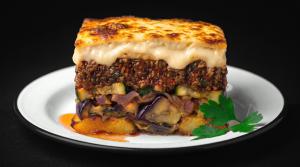
A refined update to the classic greek dish, featuring secret ingredients, precision techniques, and maximum flavor in every layer !
This past summer in Montreal, my mother and I set out to refine a family classic. By pre-salting the eggplant and zucchini and blistering them over high heat on a barbecue grill, rather than deep-frying them, we managed to cut the heavy oil and drastically concentrate their flavors. It was a revelation, but returning to my own kitchen, I knew I wanted to push the architecture of this dish even further.
The moussaka the world recognizes today is a surprisingly modern invention. Codified in the 1920s by the Greek chef Nikolaos Tselementes, the signature crown of French-style béchamel was deliberately added to "Europeanize" what was originally a much simpler Ottoman stew. Throughout the 20th century, the dish continued to evolve: clever taverna cooks added a sturdy foundation of sliced potatoes so the casserole could be cut cleanly into freestanding squares for customers, and zucchini was later layered in to lighten the dense vegetable stack.
I already have three different moussaka variations, all with braised, shredded and pulled meat, here on icookstuff.com, but it is time for a new 21st-century version. This fourth iteration, using traditional ground meat, takes that historical 20th-century blueprint and applies rigorous modern techniques to perfect it. We are utilizing strict moisture control by mimicking a barbecue char in the oven, leveraging invisible umami boosters like anchovy and cocoa powder in the heavily reduced kima (meat sauce), and introducing a highly calculated aromatic stacking in the dairy. By anchoring the béchamel with warm, earthy nutmeg and lifting it with the slightest hint of the bright, piney top-note of mastic resin (mastiha), this recipe delivers a complex, deeply resonant flavor profile wrapped in a structurally flawless slice.
In a structurally sound moussaka, the cross-section should visually break down into roughly a 40/30/30 ratio: 40% vegetable base, 30% meat sauce, 30% béchamel crown. However, I prefer a visual and taste ratio of 50/30/20 because, personally, the vegetable base is more than just a sturdy foundation.
If you were to combine every raw ingredient in this formulation, the total starting mass would be just under 4 kilograms. However, the secret to a structurally perfect moussaka is relentless moisture control. We are not building a watery stew; we are engineering a dense, freestanding slice. To achieve that, we have to track the exact mass transformation of each layer.
For the vegetable base, our foundation starts at roughly 2000 grams (the raw potatoes, eggplants, zucchini, onions, and olive oil). By pre-salting the spongy vegetables to draw out their water, followed by high-heat oven roasting for some and pan-frying for others, we intentionally strip away 50% of their total combined initial water weight. The prepared vegetables enter the casserole dish at a dense, heavily concentrated 950-1000 grams.
The meat sauce (or kima) begins as roughly 1080 grams of raw ground meat, aromatics, red wine, and crushed tomatoes. Simmering this mixture until it is tightly reduced and almost completely dry evaporates the excess liquid that would otherwise cause the moussaka to collapse. It leaves behind a jammy, highly concentrated umami core weighing approximately 700 grams.
The béchamel crown, which is our French-style topping, starts with about 720 grams of milk, butter, flour, egg yolks, and cheese. A gentle simmer thickens the roux and evaporates a small fraction of moisture, yielding a luxurious, structural topping that weighs roughly 675 grams before baking.
For the final bake, the fully assembled casserole enters the oven weighing under 2.4 kilograms. During the 45-minute bake, the dish undergoes one last evaporation phase, shedding another 250-300 grams of steam as the béchamel forms its deeply puffed, golden crust. What emerges from the oven is a highly condensed, structurally flawless casserole weighing just over 2 kilograms and yielding 9 perfectly delineated 225-gram squares.
This formulation is precisely calibrated for a deep 23 x 23 cm (9 x 9 inch) enamelled pan, yielding a beautifully high, architectural slice. If you are cooking for a larger crowd and prefer to use a universal standard 23 x 33 cm (9 x 13 inch) rectangular baking dish, the conversion is straightforward. Simply multiply all the ingredient weights and volumes by 1.5 times the original recipe weights and bake for 10-15 minutes longer. This exact 1.5x scaling ensures you maintain the precise layer ratios, the structural integrity of the vegetable base, and that thick, impenetrable béchamel seal across the larger surface area.
The meticulous steps and precise measurements might seem a bit daunting at first, but trust the process—the moment you pull that bubbling, deeply golden masterpiece from the oven, you will know every single minute was absolutely worth it.
So, are you ready for a 21st-century traditional MOUSSAKA recipe ? ... :)