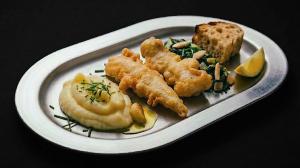
On March 25th, Greeks worldwide gather around the "national meal", a storied trio of crispy bakaliaro and creamy skordalia and vibrant horta, celebrating a dual heritage : the 1821 War of Independence and the Feast of the Annunciation.
This dual holiday always falls during Great Lent, a strict 40-day fasting period before Easter, where meat, dairy and fish with backbones are prohibited, but the Orthodox Church grants a joyful, one-day "dispensation" (katalysis) allowing the consumption of fish, oil, and wine. This preparation represents the mid-Lent pinnacle of the Greek culinary calendar.
Historically, providing fresh fish for the entire population was impossible. Inland and mountainous regions lacked the rapid transport necessary to secure fresh catches before they spoiled. Salted cod, heavily preserved and imported from the North Atlantic, provided the perfect solution. Known as the "fish of the mountain", it was affordable, shelf-stable, and could survive the arduous journey by mule to the most remote villages, allowing all Greeks to partake in the feast uniformly.
The “bakaliaro” fried battered salt cod provides the fish protein and structural crunch. The “kourkouti” (fish frying batter) varies from simple flour pastes to aerated beer-based, sparkling water-based batters and sometimes with the addition of a bit of ouzo too. I included some potato and rice starch in the batter as well as coating each cod piece in that same starch, before battering, crafted to deliver the signature shattering crunch. The addition of crushed anise seeds (reminiscent of ouzo) to the beer batter creates an herbal complexity that bridges the gap between the sea and the mountain greens.
Across Greece, the garlicky “skordalia” purée recipe adapts to the local larder, with bases ranging from the modern standard of potatoes to traditional soaked stale bread or even crushed walnuts and almonds for a richer, nut-forward texture. This regional diversity extends to the acidity, where the sharp, traditional bite of white wine vinegar is often swapped for the bright, fruity lift of fresh lemon juice and lemon zest, as I did, acting as a creamy, citrus-forward accent, to balance the heaviness of the potato, garlic and olive oil emulsion.
The boiled bitters greens (wild or not) “horta” salad may be composed of only one type or a mixture of chard, chicory, dandelion, amaranth, endives, thistle and nettle, but all I could find here were french “blettes” that are a type of chard and visually resemble bok choy but are not a cabbage. Because they are very earthy and not as bitter as wild greens, I added some crushed garlic for extra punch and toasted slivered almonds and pine nuts for crunch, obviously dressed with lots of olive oil and lemon juice.
My target was to feed 4-6 people so I needed at least 1kg of fried battered fish, 800g of skordalia and 600g of boiled greens and some rustic bread, so you can begin with these specific raw quantities to account for the physics of the kitchen such as hydration gain in the cod and heavy shrinkage in the greens or decide to increase different parts according to your needs.
Ideally, so your kitchen doesn’t look like a battlefield, start with desalting the cod pieces 24 hours before (if small) or 48 hours before (if using large pieces), then prepare the blanched greens that you can refrigerate and make the potato-garlic purée a few hours before frying the fish.
Bakaliaro & Skordalia & Horta is more than just a meal, it is a sensory map of Greek history … :)